Two human fossils dug up in northern China in the 1970s belong to the Denisovans, an extinct group of archaic humans, and help define what their skulls looked like, researchers reported in a peer-reviewed study published in Nature on October 21. The team identified the fragments from ancient proteins preserved in the bone.
Denisovans, a group closely related to the Neanderthals, remain poorly understood largely because of a sparse fossil record, Phys.org noted in its summary of the work. The new study, led by Song Xing and Qiaomei Fu of the Institute of Vertebrate Paleontology and Paleoanthropology at the Chinese Academy of Sciences in Beijing, proposes a set of skull features that the authors say Denisovan fossils share.
Proteins from a parietal bone and a jaw
The fossils come from Xujiayao, a site in the Nihewan Basin of northern China. According to the paper, 20 hominin skull, jaw and tooth fossils were excavated there between 1976 and 1979. The researchers analyzed two of them: a right parietal bone of the skull, catalogued as Xujiayao 6, and part of a right lower jaw, Xujiayao 14. They dated the material to roughly 199,000 to 138,000 years ago using a combination of uranium-series and electron spin resonance methods.
The team recovered 18 ancient proteins from the two specimens, 13 from the skull bone and 15 from the jaw, most of them collagens. Comparing those protein sequences with other ancient humans, they found an amino acid variant in collagen, known as COL1A2-996K, that is found in Denisovans but not in Neanderthals or modern humans, according to the paper and the Phys.org summary.
The researchers also took measurements and built 3D computer models of the reconstructed bones and compared them with Neanderthal, modern human and other fossil human remains. Combining that work with earlier studies, the authors list traits they consider common to Denisovans, including “a thick cranial vault,” “a massive supraorbital torus,” or heavy brow ridge, “a low cranial profile with near-parallel lateral walls,” “a flat zygomaxillary region” in the cheek area and “weak prognathism,” meaning the face projects only slightly. They also note features shared with late Neanderthals.
A wider Denisovan range
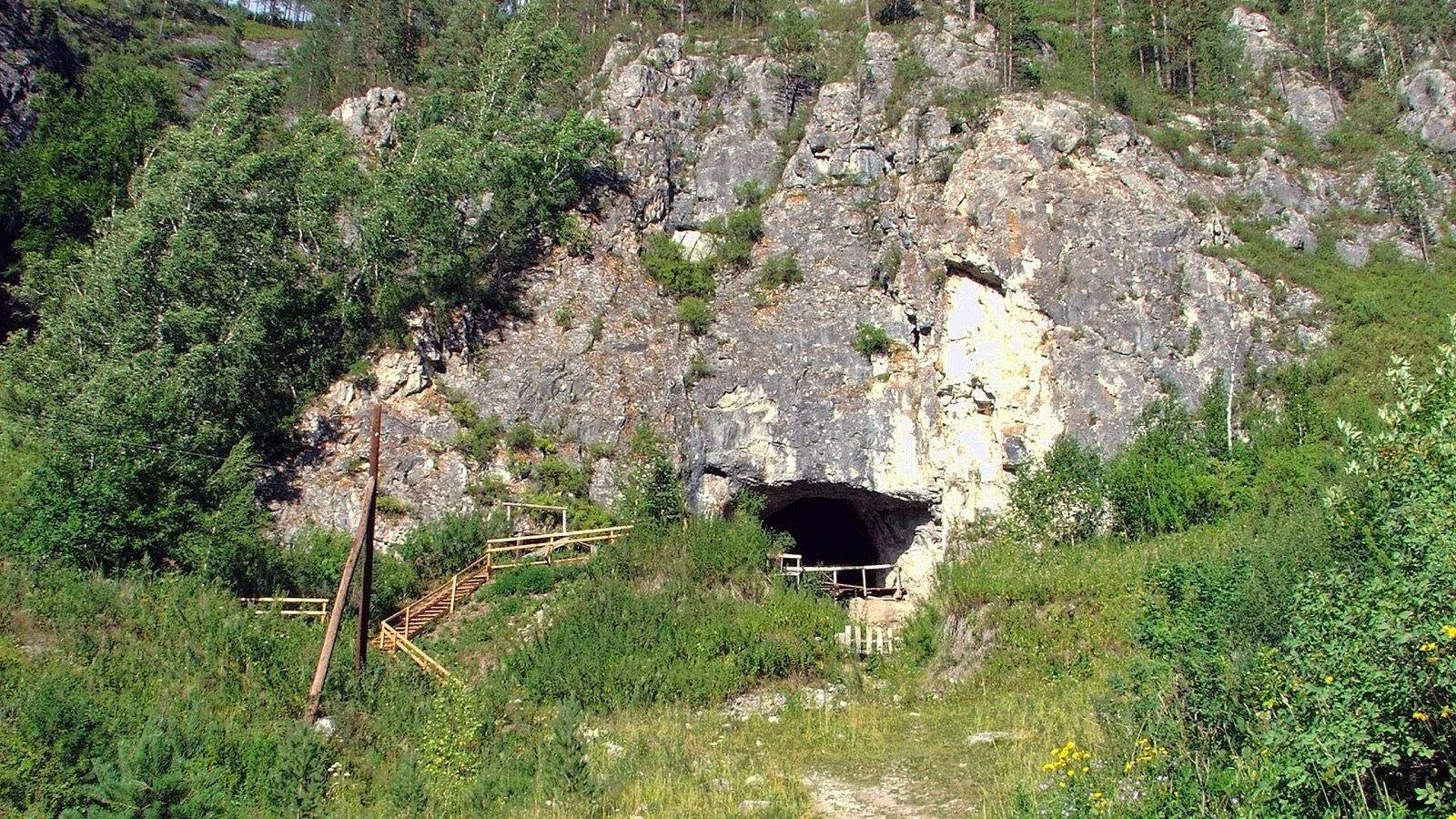
The study draws on fossils already linked to Denisovans, including a cranium from Harbin in northeastern China that is dated to about 309,000 to 146,000 years ago. The paper describes the Harbin skull as “now classified as Denisovan,” citing earlier protein and mitochondrial DNA studies led by Fu and published in 2025. Other comparisons included jawbones from Xiahe in China and from Penghu, as well as a specimen from Denisova Cave.
Taken together, the authors write, Denisovans “appear to have occupied an extensive geographical range across East Asia,” from Xiahe and Harbin in the north to Penghu in the south, and “could have lived in East Asia from at least 300 ka to 45 ka,” that is, from at least 300,000 to 45,000 years ago. Phys.org noted that Denisovans have commonly been associated with cold Siberian caves and Tibetan mountains.
The paper was received by Nature in May 2025 and accepted in September 2026. Co-authors are from the Centro Nacional de Investigación sobre la Evolución Humana in Spain, the University of Chinese Academy of Sciences, Nanjing Normal University and Peking University. Funding came from the National Key R&D Program of China, the National Natural Science Foundation of China, the New Cornerstone Science Foundation and the Chinese Academy of Sciences. The authors declared no competing interests.
Why it matters
A working description of Denisovan anatomy gives researchers a way to test whether other archaic human fossils from East Asia belong to the same lineage. The authors describe a set of shared traits linking Xujiayao and Harbin with other archaic human fossils from late Middle Pleistocene East Asia, and Phys.org reported that the researchers suggest many other fossils from the region may belong to the same Denisovan lineage.
The work also adds to what is known about where Denisovans lived and how much they varied. In the authors’ words, as quoted by Phys.org, including more East Asian fossils “expands the morphological variability of East Asian Denisovans,” and the Xujiayao identification adds a further site in northern China to the group’s known range.
The caveats
The identification rests on limited molecular evidence. Only one Denisovan-specific marker was found, and the authors acknowledge a “relatively modest amount of proteomic data.” Within the Denisovan group, the family tree they built was unstable, so the paper assigns Xujiayao only to a late Middle Pleistocene East Asian Denisovan population without placing it more precisely. The study reports no ancient DNA from the Xujiayao fossils.
The proposed trait list is also a composite. The authors note that Denisovan morphology “does not appear simultaneously in individual specimens,” meaning the features are spread across different fossils rather than seen together in one skull.
Corrections and tips: email the editor using the address on the Contact page.