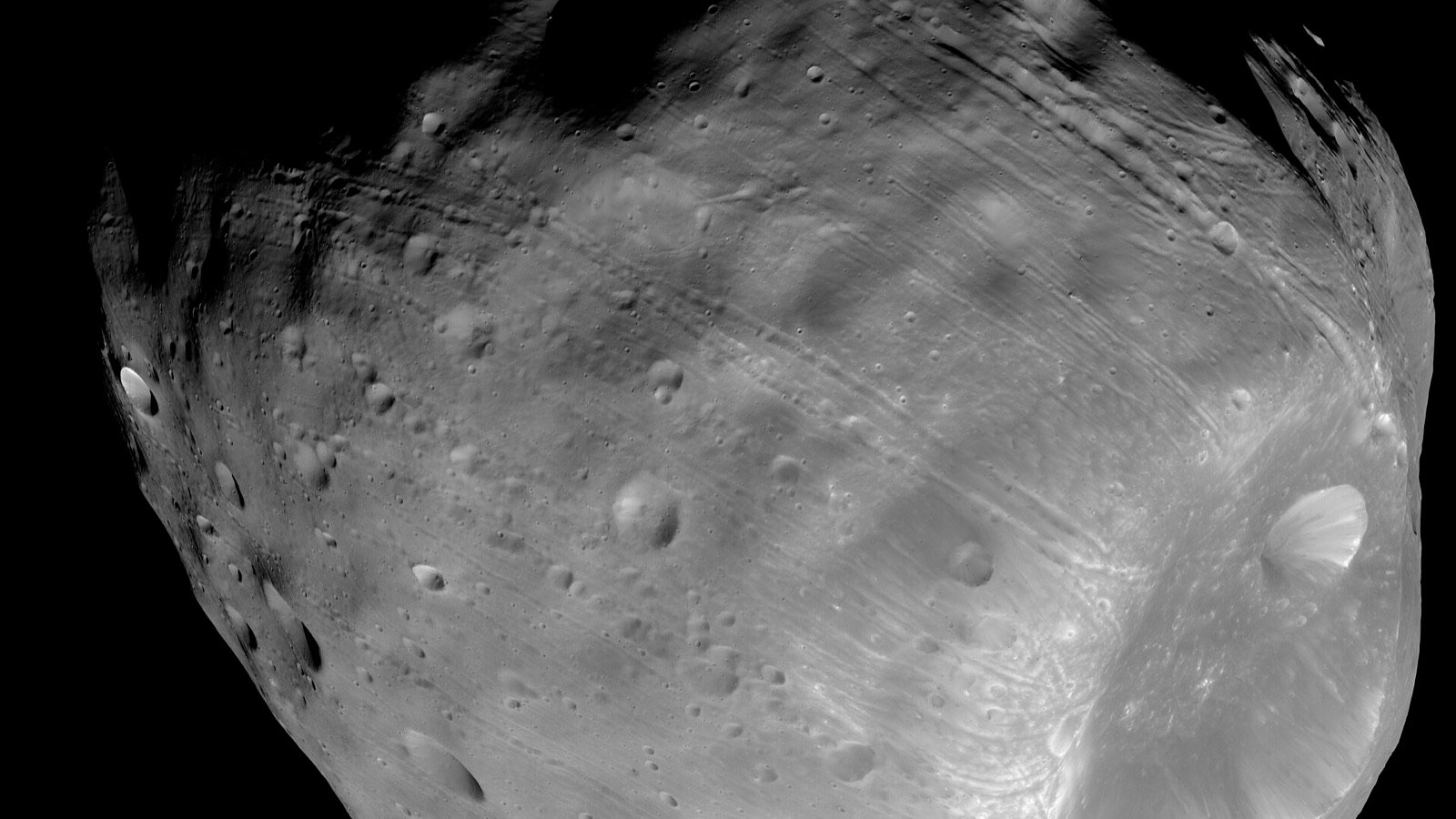
Japan’s space agency launched its Martian Moons eXploration (MMX) spacecraft on Tuesday, October 20, beginning a mission that aims to orbit the Martian moon Phobos, land on it twice and bring a sample of its surface back to Earth in 2031. The probe lifted off on an H3 rocket from the Tanegashima Space Center at 4:41 a.m. Japan Standard Time, or 3:41 p.m. EDT on October 19.
The Japan Aerospace Exploration Agency (JAXA) listed the launch, on H3 Flight No. 10, as a success. According to the European Space Agency (ESA), which contributed to the mission, MMX is set to be the first spacecraft to orbit Phobos, the first to collect samples from its surface and the first to return to Earth from the Mars system.
The mission timeline
According to JAXA’s mission page, the cruise to Mars takes about one year. The spacecraft is then to enter a so-called quasi-satellite orbit around Phobos, with detailed observations planned from 2027 to 2030. It is to collect more than 10 grams of material during two soft landings on the moon’s surface and to observe Deimos, Mars’s second moon, in the final phase of the mission.
MMX is scheduled to leave the Mars system in 2030 for a return trip of about one year. JAXA said a re-entry capsule will separate from the spacecraft in 2031 and is to be recovered in Australia. NASA, a mission partner, said sample collection will take place no earlier than 2028, after detailed surveys of Phobos.
JAXA’s mission page lists more than a dozen onboard instruments, among them a lidar and a rover. The agency describes the project as a cooperation with major European and U.S. space agencies, including the provision of onboard equipment.
International partners
NASA said its contributions include an instrument called MEGANE, built by the Johns Hopkins Applied Physics Laboratory, which detects neutrons and gamma rays from Phobos’s surface to determine the moon’s elemental makeup. NASA also supplied a technology demonstration called the Pneumatic Sampler, whose mechanism was built by Honeybee Robotics, a Blue Origin company, along with communications and navigation support from its Deep Space Network and funding for U.S. scientists on the MMX science team. NASA said it will receive and curate about 15% of the returned sample at the Johnson Space Center in Houston.
ESA said it provided the spacecraft’s deep space communication equipment and ground station support from its Estrack network, which will be used to send commands and receive data. The French and German space agencies, CNES and DLR, are also partners, according to ESA. European scientists appointed by ESA sit on the mission science team and will help plan observations and study the returned samples.
“I would like to congratulate JAXA and the entire MMX team for this successful launch,” said Carole Mundell, ESA’s director of science. Elliot Sefton-Nash, ESA’s project scientist for MMX, said: “The launch was spectacular, and JAXA’s H3 launcher performed fantastically to send MMX onward to Mars.” He added that the team was “now even more motivated to prepare for arrival at Mars next summer.”
Why it matters
Scientists have long debated how Mars got its two small moons. According to NASA, one view holds that Phobos and Deimos are debris from a massive impact on Mars, while another holds that they are ancient asteroids captured by the planet’s gravity. Measurements made in orbit and material brought back to laboratories on Earth are intended to settle the question.
“Phobos and Deimos may be the remains of a massive impact on Mars that sent material into orbit around the planet,” said Tom Statler, NASA’s program executive and program scientist for MMX. Nicky Fox, who heads NASA’s Science Mission Directorate, said: “The samples from MMX will bring forth paradigm-shifting science on the Mars system for generations to come.”
What to watch
The next milestone is arrival at Mars, expected in 2027 according to NASA and next summer according to ESA. Sampling is planned no earlier than 2028, and the capsule is due back on Earth in 2031. Deimos is to be observed in the mission’s final phase, before the spacecraft departs for Earth.
Corrections and tips: email the editor using the address on the Contact page.