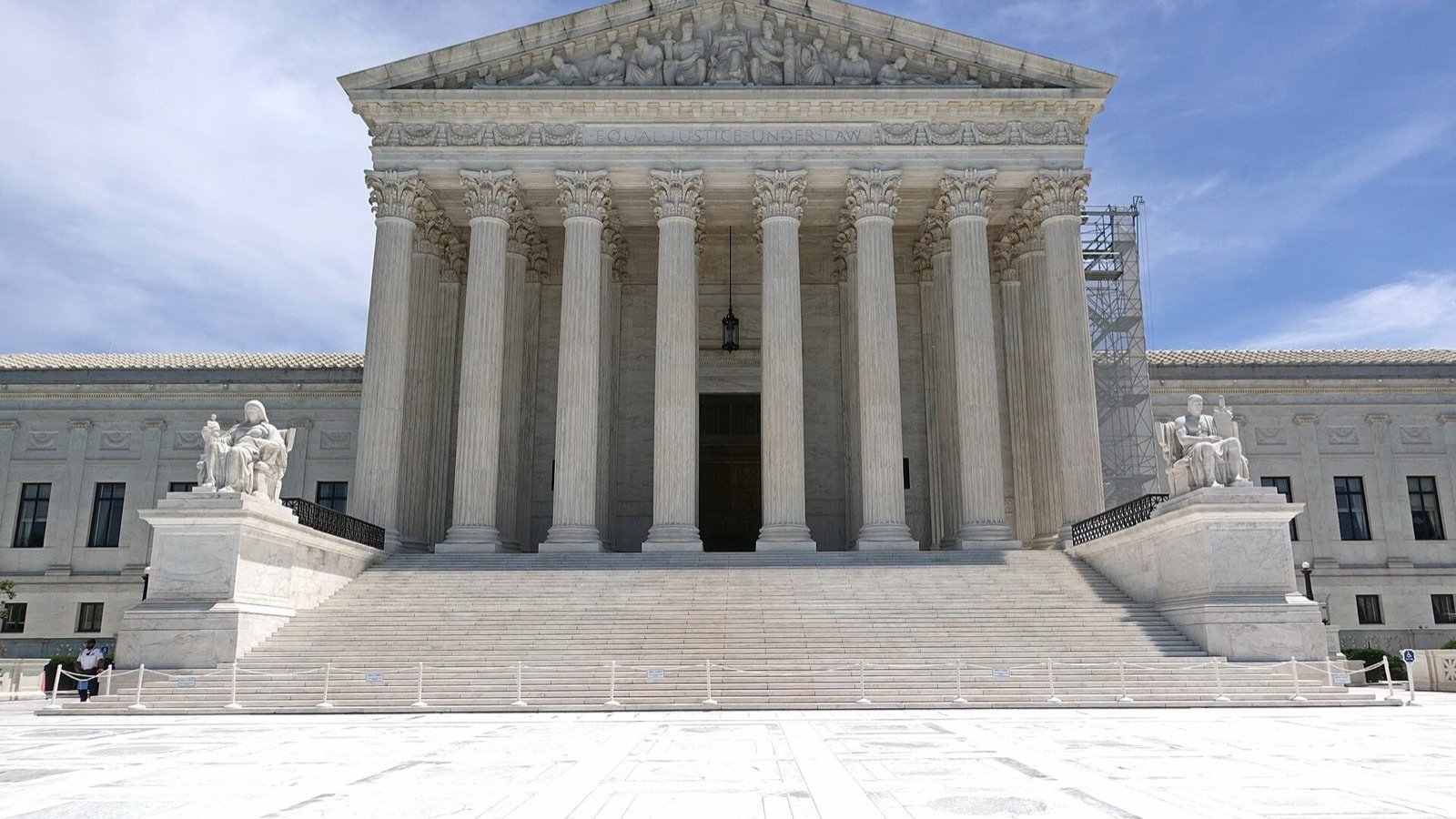
The U.S. Supreme Court on October 14 put on hold a federal appeals court order that had given the Federal Communications Commission (FCC) 48 hours to rule on a challenge over which political advertisers are entitled to discounted broadcast rates ahead of the midterm elections.
In an unsigned opinion, the court said the U.S. Court of Appeals for the Fourth Circuit was wrong to issue a writ of mandamus, an order compelling the agency to act, while the FCC was still deliberating. “Our system of separation of powers does not allow the Judiciary to meddle in ‘the workings of a coordinate branch of the Government’ in this manner,” the court wrote. Justices Sotomayor and Jackson would have denied the applications.
The dispute over the lowest unit charge
The case concerns the “lowest unit charge” (LUC), the favorable rates that federal law requires broadcasters to charge for campaign advertisements in the weeks before primary and general elections. On March 30, 2026, the FCC’s Media Bureau issued a public notice stating that political candidates, joint fundraising committees with noncandidate members, and political parties engaged in coordinated political activity were all entitled to the LUC, subject to certain conditions.
On April 29, four Democratic candidates for Congress, named in the case caption as Sherrod Brown and others, asked the full Commission to set aside the notice, arguing that only candidates are entitled to the rate. Two months later, while that application was still pending, they filed a petition for review in the Fourth Circuit seeking the same relief. The court allowed the National Republican Congressional Committee and the National Republican Senatorial Committee to take part as intervenors. The FCC, the United States and the party committees argued that the appeals court lacked jurisdiction while the application was pending and defended the notice on the merits.
On August 25, a divided Fourth Circuit panel ruled that it had jurisdiction, granted the candidates’ petition and set aside the notice, reasoning that the plain text and legislative history of the statute limit the rate to candidates. The LUC requirements had been scheduled to take effect on September 4.
Two emergency rulings
On September 4, the Supreme Court granted the party committees’ request to stay the Fourth Circuit decision. It said the Communications Act requires the Commission to resolve an application for review before a party may go to court, so the Fourth Circuit “likely lacked statutory jurisdiction,” a holding that it said split with every other circuit to consider the issue. The party committees had told the court that broadcasters were already rescinding favorable rates, which would require them to pay more for advertising “in the critical weeks leading up to the midterms.”
Justice Jackson dissented from that order, writing that the applicants were not likely to succeed on their jurisdiction argument, citing a concurring Fourth Circuit opinion that found jurisdiction because “an agency may not reserve to itself the power to defeat judicial review through delay or inaction.”
On October 7, the same Fourth Circuit panel ordered the Commission to decide the candidates’ application by October 9, which the panel described as “the only means to finally move forward with . . . judicial review.” The order came one week after the FCC’s comment period on the application closed and while a comment period on a parallel application was still under way. The FCC asked the Supreme Court for a stay, and the order was administratively paused on October 8.
In the October 14 ruling, the court said mandamus is a “drastic and extraordinary” remedy. It said the Communications Act requires the Commission to act on every application but “does not obligate the Commission to act within a particular timeframe,” and that the agency may set its own procedures and schedule. It also found the FCC would suffer irreparable harm: “That the mandamus order requires the FCC to abandon its deliberation process is itself an injury that cannot be remedied after the fact.”
Why it matters
The two orders leave the Fourth Circuit’s rulings on hold while the case continues. Under the October ruling, the FCC may set its own procedures and schedule for deciding whether only candidates qualify for the lowest broadcast rates. The candidates argue the statute limits the rate to candidates; the FCC and the Republican party committees have defended the notice extending it to parties and certain committees.
The October ruling also addresses how far courts can go in directing an agency’s schedule. The court described the Fourth Circuit’s order as requiring a final decision “just five months after it was filed and within just 48 hours—all while the Commission’s deliberation process was still ongoing.” A related stay application from the National Republican Congressional Committee was denied as moot.
What to watch
The stay of the Fourth Circuit’s October 7 judgment lasts until a petition for certiorari is filed and decided, if one is timely sought. If the court denies certiorari, the stay ends automatically; if it grants review, the stay remains until the court issues its judgment. The candidates’ application and the parallel application remain before the FCC.
Corrections and tips: email the editor using the address on the Contact page.