Francis Halzen, a Belgian-born physicist at the University of Wisconsin–Madison, has won the 2026 Nobel Prize in Physics for his role in creating the IceCube Neutrino Observatory at the South Pole and for the discovery of high-energy neutrinos arriving from space. The Royal Swedish Academy of Sciences announced the award in Stockholm on Tuesday, October 6.
The academy honored Halzen “for decisive contributions to the IceCube Neutrino Observatory” and “the discovery of high-energy neutrinos of astrophysical origin,” according to an announcement posted by the IceCube collaboration. The prize is worth 12 million Swedish kronor, about $1.2 million, The Associated Press reported. Halzen, 82, is IceCube’s principal investigator and holds the titles of Vilas Research Professor and Gregory Breit Professor at UW–Madison.
Mark Pearce, chair of the Nobel Committee for Physics, said in a news release quoted by the AP: “Francis Halzen has led an international team of researchers and engineers who have provided us with a fantastic instrument.” He added: “His tenacity and scientific vision has paved the way for a new kind of astronomy.”
Catching ghost particles in Antarctic ice
Neutrinos are tiny, extremely light particles that pass through the human body constantly. According to the AP, scientists cannot observe them directly and instead measure what happens in the rare cases when a neutrino collides with other matter, producing flashes of light or charged particles. Halzen’s work on capturing neutrinos at the South Pole dates back to the 1980s, the AP reported.
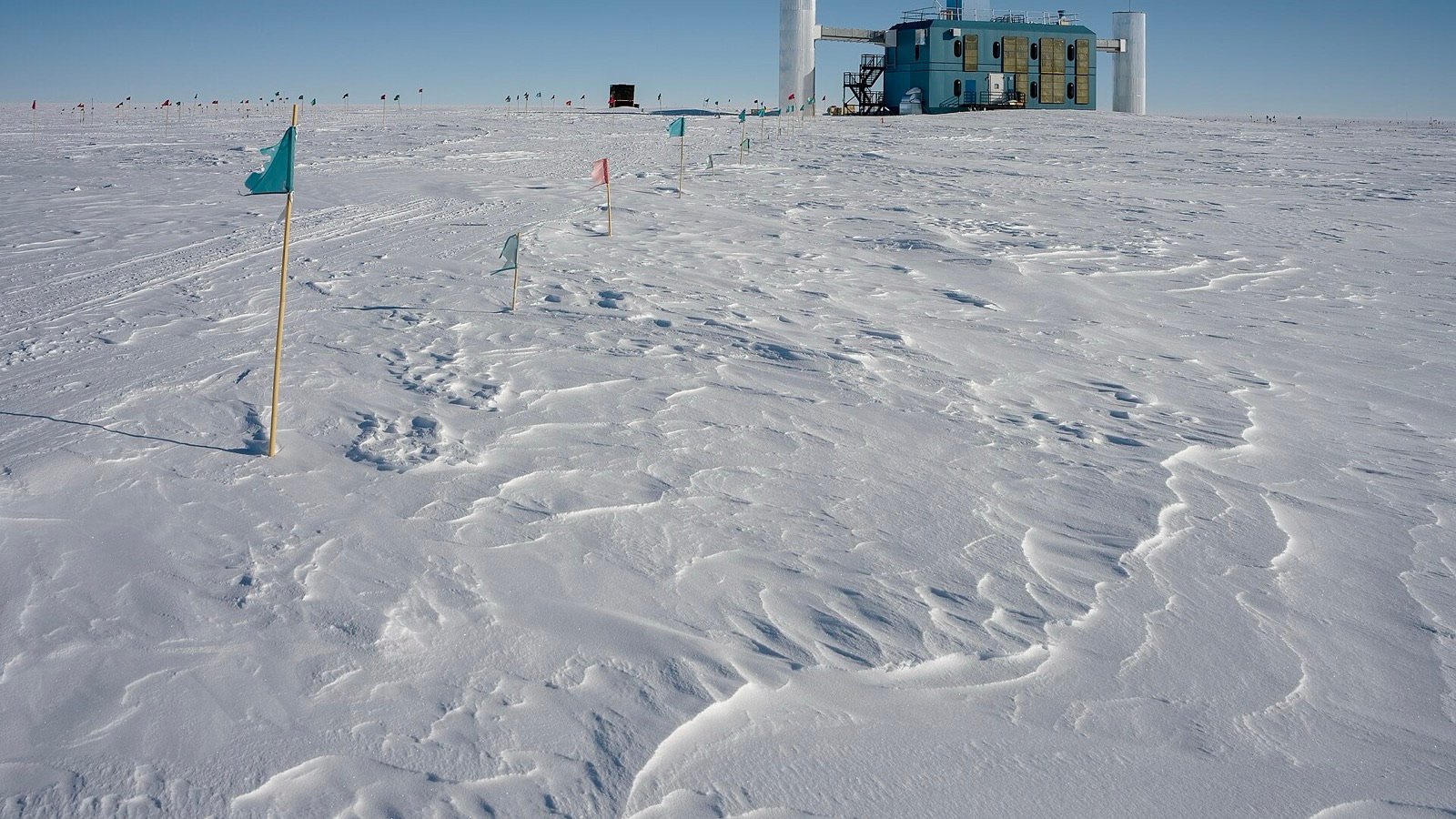
The IceCube collaboration credits Halzen with proposing that Antarctic ice could serve as the detection medium for high-energy neutrinos from space, and with helping to form the collaboration that built the observatory. IceCube is a U.S. National Science Foundation (NSF) facility that instruments about one cubic kilometer of glacial ice and is operated mainly through an NSF award to UW–Madison.
According to the project’s technical description, the in-ice detector holds 5,160 digital optical modules strung on 86 cables, or strings, of 60 sensors each. The sensors sit between about 1,450 and 2,450 meters below the surface. When a neutrino interacts in the ice, it produces charged particles that emit what is known as Cherenkov light; the modules record and time-stamp that light so computers can reconstruct the particle’s direction and energy.
Strings were lowered into holes drilled during seven austral summers, and the last one went in on December 18, 2010. The project’s page puts the total cost at $279 million, of which the NSF provided about $242 million and the rest came from international and U.S. funding agencies.
What IceCube found
In 2013 IceCube reported the discovery of high-energy neutrinos of astrophysical origin, although their sources were then unknown, according to the collaboration. It has since reported neutrino emission from two galaxies, TXS 0506+056 and NGC 1068, also known as Messier 77, and in 2023 announced neutrinos from the Milky Way.
The collaboration today has about 450 scientists from 58 institutions in 14 countries. Funding comes from agencies in Australia, Belgium, Canada, Denmark, Germany, Italy, Japan, New Zealand, South Korea, Sweden, Switzerland, Taiwan, the United Kingdom and the United States.
Halzen spoke to the Nobel committee by phone from Italy. “It was a great surprise and I obviously didn’t expect it,” he said, according to the AP. In a statement released by IceCube, he said: “It’s a great relief for me to finally deliver the recognition that this great collaboration deserves.” Erin O’Sullivan, the collaboration’s spokesperson, said: “We are very proud of our research with IceCube and congratulate Francis on his well-deserved Nobel Prize.”
Why it matters
The prize recognizes the use of neutrinos, rather than light alone, as a tool for astronomy. The AP described the rare class of neutrinos Halzen studied as messengers from the cosmos that may help reveal how the universe evolved, and the committee chair said his vision had “paved the way for a new kind of astronomy.” Since the 2013 discovery, the collaboration has reported neutrino emission from two other galaxies and from the Milky Way, according to IceCube.
The award also recognizes a facility that depends on sustained public funding and international cooperation. IceCube was built and is run by agencies and universities in 14 countries, and Halzen’s own statement presented the prize as recognition for the collaboration as a whole. The prize follows last year’s physics award, which went to three scientists for research on quantum tunneling, according to the AP.
What to watch
The observatory is still expanding. According to the collaboration, an extension called the IceCube Upgrade was installed in 2025–2026 to lower the detector’s energy threshold and improve calibration of the ice, with first science data expected later this year. A proposed successor, IceCube-Gen2, would add an optical array with eight times IceCube’s volume and a radio component designed to detect neutrinos at even higher energies. That project has been proposed but not yet built.
Corrections and tips: email the editor using the address on the Contact page.