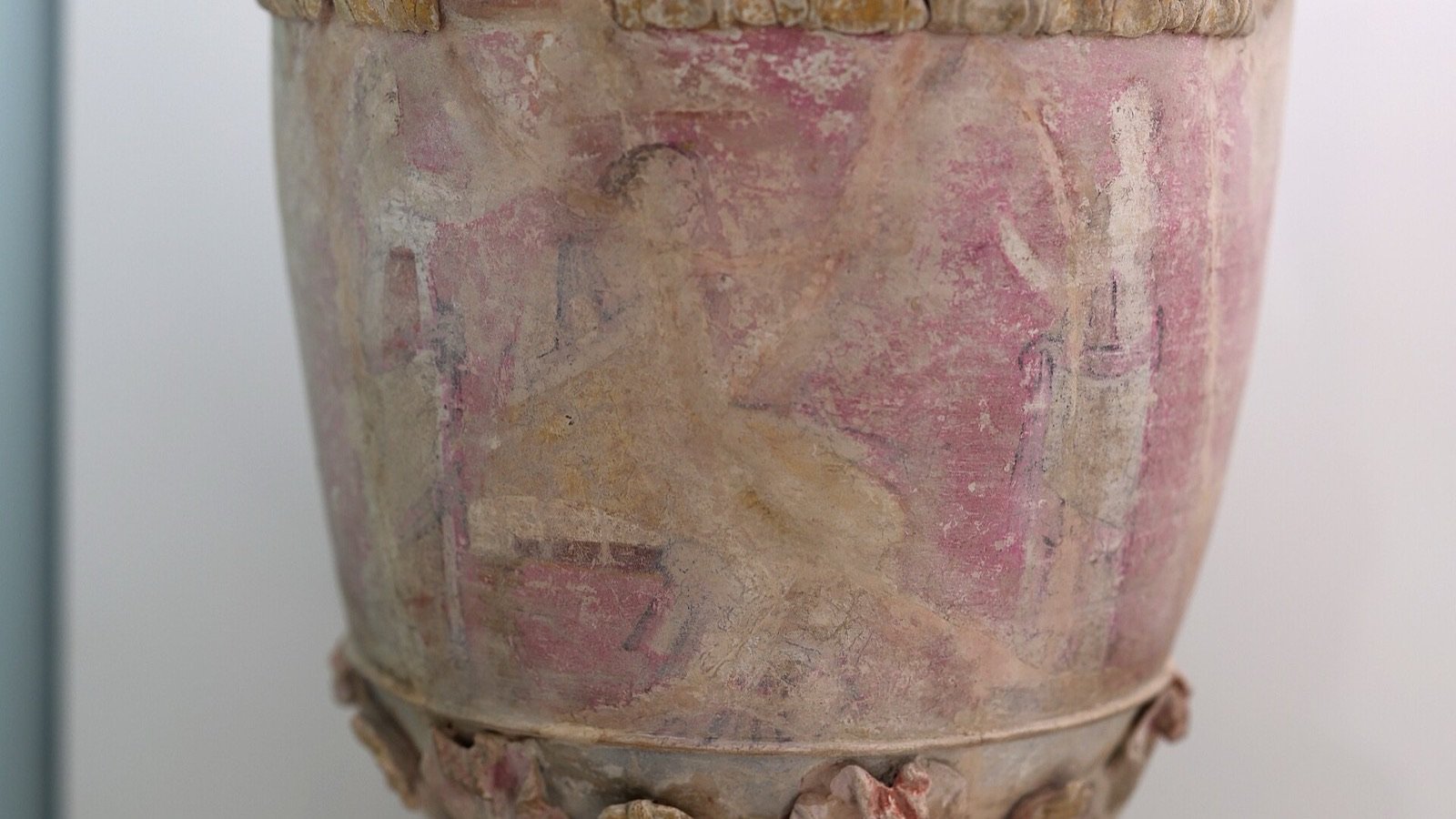
The Allard Pierson, the museum of the University of Amsterdam, returned a painted ceramic vase from the third century BCE to Sicily on Wednesday, October 7, after research showed that the object’s stated history could not be true. The museum said it had no legal obligation to give the vase back and was doing so voluntarily, on moral grounds.
The object, known as the Centuripe pyxis, is a lidded storage vessel made of local clay and decorated in several colors. According to the museum, it shows a wedding scene watched over by Apollo, with several love gods on the lid. It belongs to a small group of such vessels made near Centuripe, a town in Sicily whose pottery is marked by “relief decorations with multicoloured painting,” dominated by shades of yellow and pink.
The museum said the pyxis would be formally handed over at a ceremony at the Allard Pierson in Amsterdam. The Sicilian side was to be represented by the regional minister and the director-general of the Region of Sicily’s department of cultural heritage and Sicilian identity, together with the Italian Carabinieri’s cultural heritage protection unit. The vase is to go on permanent display at the Regional Museum of Centuripe.
How the provenance unraveled
The Allard Pierson bought the pyxis in 1997 from a Swiss art dealer at TEFAF Maastricht, the art and antiques fair. The seller said it had been in private Swiss ownership since before 1970, the year the UNESCO convention on the illicit trade in cultural property was drawn up. According to the museum, no provenance documentation or export license was supplied with the sale.
In 2017, an investigation by the Carabinieri’s cultural heritage protection unit in Palermo, working under the public prosecutor’s office in Enna, traced photographs of the pyxis that had come into the possession of SiciliAntica, the historical society in Centuripe. According to the museum, the same set of photographs included a group picture of a wedding that took place in Centuripe in 1976. The museum said this pointed to the vase having come from the illicit trade rather than an old Swiss collection, and noted that clandestine excavations near Centuripe are documented. Sicilian authorities asked for the vase back in 2017.
A decorative element that once sat on top of the lid was not part of the 1997 purchase, and its whereabouts are unknown, the museum said.
No legal duty to return
The UNESCO treaty, formally the Convention on the Means of Prohibiting and Preventing the Illicit Import, Export and Transfer of Ownership of Cultural Property, was adopted in Paris on November 14, 1970, and entered into force on April 24, 1972, according to UNESCO. The museum noted that “the Netherlands did not ratify the 1970 UNESCO Convention until 2009,” and that the legislation does not apply retroactively. That left the museum free to keep the pyxis; it chose to return it.
Rogier Kalkers, head of provenance research at the Allard Pierson, said “this restitution does not mark an end, but rather the beginning of further collaboration.” Francesco Paolo Scarpinato, Sicily’s regional minister for cultural heritage and Sicilian identity, described the return as “this act of great generosity and responsibility” and said: “We are extremely proud and delighted by this homecoming.”
A joint research project
After the ceremony, the museum said, it would set up a working group of Sicilian and Dutch experts to study the pyxis and similar objects, using analysis of clay and pigments alongside stylistic study. The museum did not name the members or give a timetable.
Laurien de Gelder, curator of the museum’s archaeological collections for the Near East and the Greek world, said: “Objects from this region have a history of looting, plunder and forgery.” As a result, the museum said, little is known about the archaeological context of Centuripe pottery, and the authenticity of some objects and their painting has been questioned. Through the joint work, de Gelder said, “we hope to gain a better understanding of the production and authenticity of this type of pottery.”
The return follows an announcement in February that Rubicon Impact & Litigation, an Amsterdam law firm, would fund a three-year fellowship for provenance research into the Allard Pierson’s archaeological collections, including possibly unlawful past acquisitions and illegal practices in the antiquities trade.
Why it matters
The case shows how a single piece of photographic evidence can overturn a dealer’s account of where an object came from, decades after a sale. Because the Netherlands ratified the 1970 convention only in 2009 and the legislation is not retroactive, the museum said it was under no legal obligation to return the pyxis; the decision to do so was its own.
For Sicily, the pyxis goes back to a museum in the town near which it was made. For researchers, the planned study addresses a gap the museum itself identified: with so many Centuripe objects looted or of uncertain authenticity, scientific analysis of securely sourced pieces could help clarify how this type of pottery was produced.
The caveats
The account of the 2017 investigation and the evidence it uncovered comes from the museum’s statement. The statement does not name the Swiss dealer who sold the vase.
Corrections and tips: email the editor using the address on the Contact page.